
By Jonathan Sargent, owner of Sargent Pest Solutions. Jonathan holds a Master’s degree in entomology from Clemson University and has served homeowners and businesses across Greenville and the Upstate since founding the company in 2005.
If you’ve walked out to your car on a November morning in the Upstate and found a golden web stretched across the driveway — with a large, brightly colored spider sitting in the middle of it — you’re not alone. This is the time of year Joro spiders are at their biggest and most visible, and it’s also the time of year we get the most questions about them.
The short version: Joro spiders are an invasive species, they are striking to look at, and they are here to stay in the Upstate. But they are not aggressive, and they are not known to be a biting concern. Understanding their life cycle goes a long way toward taking the worry out of what you’re seeing.
Joro Spiders at a Glance
- What they are: A non-native orb-weaving spider (Trichonephila clavata) from East Asia.
- First found in the U.S.: The Athens, Georgia area in 2014, most likely the result of an accidental introduction before that.
- Size: Females are 1 to 3 inches and brightly colored. Males are much smaller — under an inch.
- Webs: Large, yellow-gold webs that can be several feet across.
- Life cycle: Eggs hatch in April or May, spiders mature through summer, adults lay eggs before the first frost and die over winter.
- Bite risk: Venomous like all spiders, but not aggressive and not known to be a biting concern.
Where Did Joro Spiders Come From?
Joro spiders were first found in the Athens, Georgia area in 2014. They were most likely the result of an accidental introduction that happened before that — invasive species rarely get noticed the moment they arrive. Clemson Cooperative Extension notes they likely reached the U.S. by hitchhiking on shipping containers, and that local residents may have been seeing them in north Georgia for several years before they were formally documented.
From northeast Georgia, the Upstate was a short trip. Joro spiders were first documented in South Carolina in 2018, and in the years since, they’ve become a familiar sight across Greenville, Spartanburg, Anderson, Pickens, and Oconee counties. Clemson Extension now reports them beyond the Upstate as well, into the Piedmont and Sandhills regions of the state.
How to Identify a Joro Spider
Joro spiders are one of the easier spiders to identify once you know what to look for, largely because the females are so large and so colorful.
Females
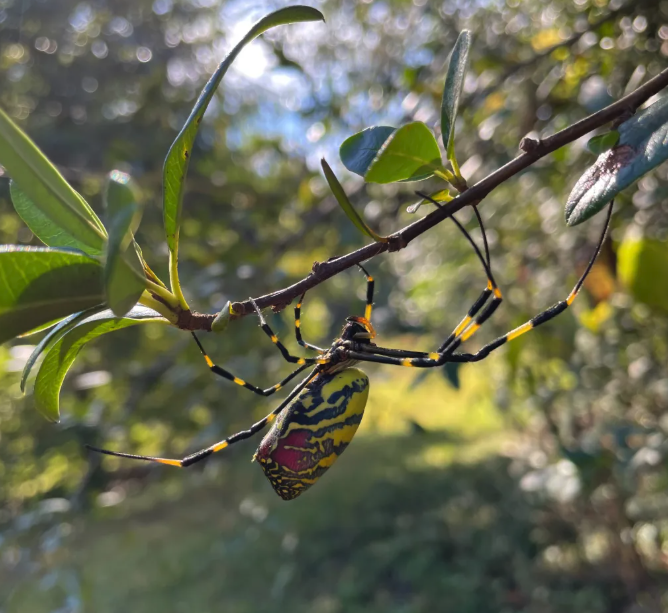
The female is the spider most people notice. Females are 1 to 3 inches in size, brightly colored, and make large webs. You’ll typically see yellow and blue-black banding, and many have red or pinkish markings on the underside — a helpful detail for telling them apart from native look-alikes.
Males
Males are much smaller — less than 1 inch — and far less noticeable. They’re typically found on the edges of a female’s web, so if you see one large spider in the center and one or two small ones near the margins, you’re very likely looking at a female Joro with males nearby.
The Web
The adult’s web is often the first clue. It can be several feet across and has a distinctive yellow-gold color that catches the light. Joro spiders build webs high and in open spaces — between trees, along eaves, across porches and carports, and on power lines — which is why so many people discover them by walking straight into one.
A Common Look-Alike
Upstate homeowners sometimes confuse Joro spiders with the native yellow garden spider, which is also large, yellow, and black. The red or pink coloring on the Joro’s underside and its golden, irregular-looking web are good ways to tell the difference. If you’re not sure, a clear photo is usually enough for a positive ID.
The Joro Spider Life Cycle in the Upstate
The single most useful thing a homeowner can understand about Joro spiders is their annual cycle. It explains why they seem to appear out of nowhere in late summer, why they’re everywhere in the fall, and why they disappear in winter.
| Season | What’s Happening |
|---|---|
| April – May | Eggs hatch. Each egg sac can contain 400 to 500 spiderlings. |
| Late Spring | Spiderlings “balloon” — releasing silk strands that catch wind currents — to reach the tops of trees and separate themselves from the other spiderlings. |
| Summer | Spiders grow and reach maturity throughout the summer. Webs get larger and more noticeable as the season goes on. |
| Fall | Adult females are at full size and highly visible. Before the first frost, adults lay their eggs. |
| Winter | The adults die over winter. The egg sacs remain and hatch the following spring. |
Why Ballooning Matters
Ballooning is how a single egg sac turns into a neighborhood full of spiders. Newly hatched spiderlings let their silk strands catch the wind and carry them up and away — reaching the tops of trees and spreading out from their siblings. It’s also a big part of how Joro spiders have expanded their range so quickly across the Southeast. Joro spiders don’t fly, and they don’t “jump” at people; ballooning is a short-lived dispersal behavior of the youngest spiders.
Why You’re Seeing Them Now
By November, the Joro spiders you see are adults at the very end of their life cycle. They’ve spent all summer growing, which is why they look so much bigger now than they did in July. Before the first frost, they’ll lay their eggs, and the adults will die over winter. Next spring, the egg sacs will hatch and the cycle will start again.
Are Joro Spiders Dangerous?
This is the question we hear most often, and it’s an understandable one. A brightly colored, three-inch spider sitting at eye level doesn’t exactly look friendly.
“While Joro spiders are venomous — like all spiders — they are not aggressive and are not known to be a biting concern.”
— Jonathan Sargent, Master’s Degreed Entomologist
Every spider is technically venomous — that’s how spiders subdue their prey. What matters for people is whether a spider is likely to bite and whether its venom is medically significant. Joro spiders score low on both counts. Clemson Extension describes them as docile, notes that their venom is not considered medically relevant to people, and points to recent research showing a Joro has to be seriously provoked — pinched or squeezed — before it will bite at all.
That’s very different from the two spiders in the Upstate that do warrant real caution: the black widow and the brown recluse. Neither of those builds the big, open, golden webs that Joro spiders do.
What Should You Do About Joro Spiders on Your Property?
For most homeowners, the honest answer is: not much. Joro spiders aren’t trying to get into your house, and they aren’t a threat to your family or pets. If a web is out of the way, it’s perfectly reasonable to leave it alone — the adults won’t survive the winter.
When a web is in a doorway, across a walkway, or somewhere you simply don’t want it, Clemson Extension’s guidance is straightforward:
- Physical removal works. A broom or stick is enough to take down a web and move the spider.
- If you use a spray, use one labeled for spiders. Products labeled for spider control are available at home and garden stores. Avoid improvised products that aren’t labeled for this use — they can damage property and put people and pets at risk.
- Check what you’re moving. University of Georgia Extension notes that female Joros attach egg sacs to leaves, tree bark, and flat surfaces — including potted plants and vehicles — which is one way they spread to new areas.
If you’re dealing with a large number of webs around your home or business, or you’re not sure what kind of spider you’re looking at, we’re glad to help. You can call or text (864) 915-5555 or contact us online and talk with us about what you’re seeing. You can also learn more about our full range of pest control services.
Should You Report Joro Spider Sightings?
Researchers are still learning how Joro spiders affect native species, and Clemson Extension has reported growing evidence that native orb-weaving spiders decline where Joro populations are high. If you’d like to contribute, Clemson asks residents to log sightings on iNaturalist or Joro Watch. A photo and a location are all it takes.
Frequently Asked Questions About Joro Spiders
Are Joro spiders poisonous or dangerous to people?
Joro spiders are venomous, like all spiders, but they are not aggressive and are not known to be a biting concern. Their venom is not considered medically significant to people.
Are Joro spiders dangerous to pets?
No. Clemson Extension does not consider Joro spiders a threat to people or pets.
When do Joro spiders go away?
Adults lay their eggs before the first frost and die over winter. In the Upstate, you’ll see far fewer of them once the colder weather settles in.
When do Joro spider eggs hatch?
Joro spider eggs hatch in April or May. Each egg sac can contain 400 to 500 spiderlings.
How big do Joro spiders get?
Female Joro spiders are 1 to 3 inches in size. Males are much smaller — less than an inch — and are usually found on the edges of a female’s web.
Can Joro spiders fly?
Not in the way people imagine. Young spiderlings “balloon” by letting their silk strands catch wind currents, which carries them to treetops and away from other spiderlings. Adult Joro spiders stay in their webs.
Will Joro spiders come inside my house?
Joro spiders build webs outdoors — on trees, eaves, porches, and other open structures. They are not an indoor pest.
The Bottom Line
Joro spiders are a new and very visible part of life in the Upstate. They’re large, colorful, and their webs can show up just about anywhere in the fall. But once you understand the life cycle — spring hatch, summer growth, fall egg-laying, and a winter die-off — they become a lot less mysterious. They’re not aggressive, they’re not known to be a biting concern, and the adults you’re seeing this month won’t be around much longer.
If you have questions about Joro spiders or any other pest around your home or business, call or text Sargent Pest Solutions at (864) 915-5555. We’re a family-owned company serving Greenville and the Upstate since 2005, and we’re always glad to help you understand what you’re seeing.