
A South Carolina Home Buyer’s and Seller’s Guide to the Wood-Destroying Insect Inspection
By Jonathan Sargent, M.S. Entomology (Clemson University) • Founder, Sargent Pest Solutions • Serving Greenville & the Upstate since 2005
Updated June 2026
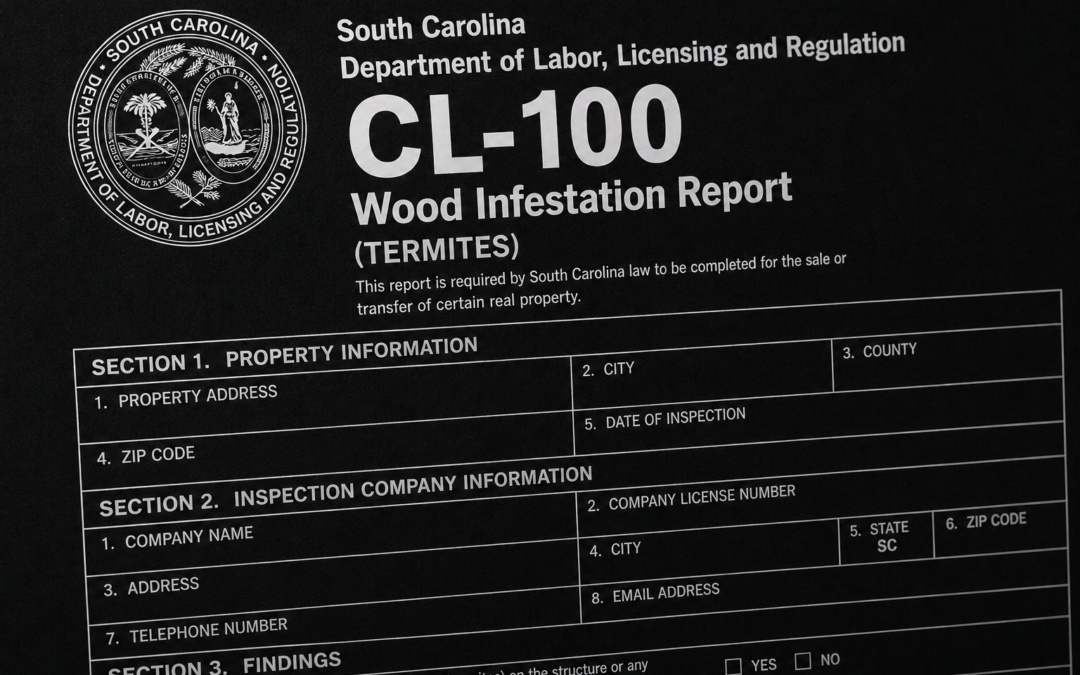
If you are buying or selling a home in South Carolina, there is one termite-related document you will almost certainly encounter: the CL-100. Late spring through summer is the Upstate’s busiest stretch for real estate, and a steady flow of new residents keeps it that way. This guide explains what the CL-100 is, what it inspects for, when you need one, who is responsible if a problem is found, and why it is designed to be an independent, third-party report.
The Short Version
|
What Is a CL-100 Report?
“The CL-100 report is the report in the state of South Carolina — and it’s only in our state — that has to be used in a real estate transaction for your wood-destroying insect inspection.”
— Jonathan Sargent
In other words, it is the official wood-destroying insect (WDI) inspection report used when a home changes hands in South Carolina. The name itself points to its origin:
“The CL in CL-100 stands for Clemson, because they’re the ones that made it.”
— Jonathan Sargent
What Does a CL-100 Inspection Look For?
“It looks for three big things: termites — whether active, previous, or termite damage — other wood-destroying insects like beetles and carpenter ants, and then it also looks for moisture.”
— Jonathan Sargent
| What It Checks | What That Covers |
|---|---|
| Termites | Active infestation, evidence of previous activity, or existing termite damage |
| Other wood-destroying insects | Pests such as wood-boring beetles and carpenter ants |
| Moisture | Excess moisture conditions that can damage wood or attract pests |
Any of these three can appear on an inspection at any time, which is why the report looks at all of them together rather than termites alone.
When Do You Need a CL-100?
The CL-100 is tied to the real estate transaction itself. In practice, it is requested as part of buying or selling a home, and the mortgage company relies on it before funding the purchase. Because it has to be current for the closing, timing matters: it is generally ordered as the transaction moves toward closing rather than far in advance.
If you are selling, having the inspection done in good time gives you room to address anything that comes up. If you are buying, the CL-100 is part of how you confirm the home you are purchasing does not carry an undisclosed termite, insect, or moisture problem.
What Happens If the Inspection Finds a Problem?
If the inspection turns up an issue — active termites, other wood-destroying insects, or a moisture problem — it generally falls to the seller to resolve it before the transaction can close. As a practical matter, the mortgage company will not release the funds to complete the purchase until the flagged issue has been addressed. That is what gives the CL-100 its weight in a transaction: it is not merely informational, it can directly affect whether and when a sale closes.
Why Is the CL-100 a Third-Party Inspection?
Clemson is deliberate about keeping the CL-100 independent. The report is meant to be an honest assessment of the home, not a way to generate repair or treatment business.
“Clemson really puts an emphasis on the fact that you can’t use the CL-100 inspection as a sales tool. They really want a true third-party investigator looking at the house, not using it as a sales inspection.”
— Jonathan Sargent
This is worth understanding as a buyer or seller: the value of the report comes from its independence. The preference is for one company to perform the inspection without turning it into an estimate for fixing whatever is found.
Can the Same Company Inspect, Treat, and Repair?
Sargent Pest Solutions performs CL-100 inspections, and if an issue is found, the company can treat for termites and beetles and handle most moisture situations. What it intentionally does not do is structural repair work.
“We don’t repair damage. We prefer to send that out to experts and general contractors who are true experts in their field.”
— Jonathan Sargent
That division of labor keeps the focus where the expertise is — identifying and treating pests and moisture — while leaving structural repairs to licensed contractors who do that work every day.
How to Prepare for a CL-100 Inspection
Because moisture is one of the three things the report evaluates, the condition of areas like the crawlspace matters. Keeping moisture under control, addressing leaks, and ensuring the inspector can access the spaces that need to be examined all help the inspection go smoothly. For sellers especially, addressing a known moisture or pest issue before the inspection — rather than after it appears on the report — keeps a transaction moving.
Frequently Asked Questions
What does CL-100 stand for?
The “CL” stands for Clemson, the university that developed the report. It is South Carolina’s standard wood-destroying insect inspection report.
Is the CL-100 required to sell a house in South Carolina?
It is the wood-destroying insect report used in most South Carolina real estate transactions, and mortgage companies rely on it before funding a purchase. It is specific to South Carolina.
What does a CL-100 inspection check for?
Three things: termites (active, previous, or damage), other wood-destroying insects such as beetles and carpenter ants, and moisture.
Who pays to fix problems found on a CL-100?
Generally the seller must resolve flagged issues before closing, because the mortgage company typically will not release funds until the problem has been addressed.
Can the company that does my CL-100 also fix the damage?
Clemson emphasizes that the CL-100 should be an independent inspection rather than a sales tool. Sargent Pest Solutions performs the inspection and can treat for termites, beetles, and moisture, but refers structural repairs to general contractors.
How long is a CL-100 good for?
Because it must reflect current conditions for the closing, it is generally ordered as the transaction approaches closing rather than far ahead of time. Your real estate professional can advise on timing for your specific transaction. Officially, the report is good for 30 days. If your closing gets extended, there is a chance you would need another CL-100.
About the Expert
| Jonathan Sargent, M.S. Entomology Jonathan Sargent earned his master’s degree in entomology from Clemson University, where he was the state extension entomologist’s first graduate student. He founded Sargent Pest Solutions in Greenville, South Carolina, in 2005, and in 2026 identified the first confirmed Formosan termite colony in Greenville County — a finding verified by Clemson University. Sargent Pest Solutions serves homeowners across Greenville, Taylors, and the Upstate of South Carolina, with a focus on education, experience, and excellence — treating pest control as a partnership with each customer rather than a rushed transaction. |
Buying or selling a home in the Upstate? Contact Sargent Pest Solutions to schedule a CL-100 inspection with an independent, entomologist-led team.
| Part of Our Upstate Termite Guide This article is one piece of a connected guide series. For the full overview, start with the main pillar guide below; the other articles go deeper on specific topics.
|