
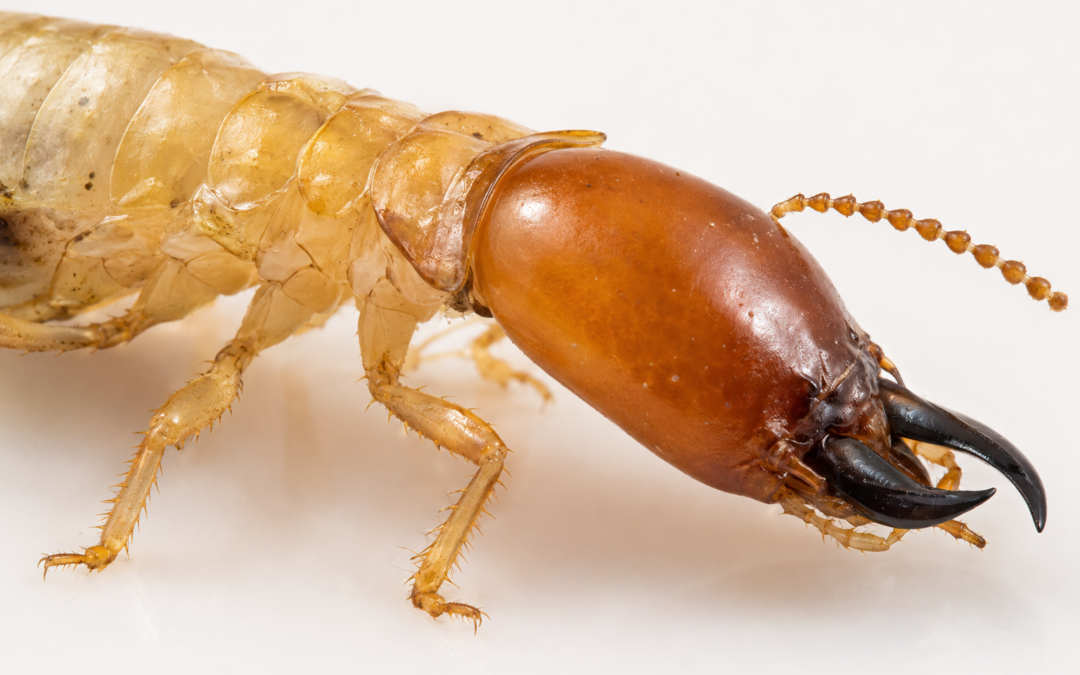
By Jonathan Sargent, M.S. Entomology (Clemson University) • Founder, Sargent Pest Solutions • Serving Greenville & the Upstate since 2005
Termites are one of the most damaging pests a home in the Upstate can face, and they are also one of the most misunderstood. They work silently, hide deliberately, and often go unnoticed until the damage is already done. For homeowners around Greenville, Taylors, and the surrounding Upstate, understanding how termites behave — and what genuinely protects a house — is worth far more than any quick spray.
This guide is built from the field experience of Jonathan Sargent, who holds a master’s degree in entomology from Clemson University and has run Sargent Pest Solutions in Greenville since 2005. It covers the termite species we actually deal with here, why they are so hard to detect, the recent discovery of the first confirmed Formosan termite colony in Greenville County, how to read swarm season, what a CL-100 report means for a real estate transaction, and how to think about protecting your home.
Quick Answers for Upstate Homeowners
- The Upstate has subterranean termites — not drywood termites — so the colony lives in the ground and forages into wood, including your home.
- Termites are a “cryptic species.” A clean visual inspection does not prove your home is termite-free; only treatment reaches the hidden areas where they live.
- The first confirmed Formosan termite colony in Greenville County was identified by Sargent Pest Solutions in Taylors, SC, and verified by Clemson — a noteworthy find that shows the value of careful, knowledgeable inspection.
- Termite swarmers appear mostly in early-to-mid spring. Seeing swarmers inside means a mature colony (3–5 years old) is already established.
- South Carolina’s CL-100 report is required for most real estate transactions and checks for termites, other wood-destroying insects, and moisture.
- Termite damage is common — and almost entirely preventable with inspection, treatment, and a warranty.
What Kinds of Termites Live in Upstate South Carolina?
If you have seen photos of a house wrapped in a giant tent for fumigation, that is a drywood termite treatment — and it is not something we deal with here. The Upstate’s termite problem is a different animal entirely.
“We don’t have the drywood termite that you see people put big tents over their house. What we do have are called subterranean termites, which means the queen and most of the colony is down in the ground.”
— Jonathan Sargent
Subterranean termites keep the queen and the bulk of the colony underground. They forage out of the soil into old tree stumps, scrap wood left on the ground, and — when the opportunity presents itself — the structure of your home. The Upstate is home to three main species of subterranean termite, and for the purposes of a homeowner they behave similarly: they are destructive, persistent, and very good at staying out of sight.
The most important thing to understand is that the damage they cause is not inevitable.
“We come across termite damage all the time, and the worst part is, it’s all preventable.”
— Jonathan Sargent
Having a home inspected, treated, and placed under a warranty is a straightforward way to prevent slight-to-severe termite damage before it ever starts.
Why Are Termites So Hard to Detect?
Termites are not just hidden by accident — hiding is their survival strategy. Entomologists call them a cryptic species.
“Termites are what’s called a cryptic species. They do everything they can to hide. They don’t want birds to find them, they don’t want ants to find them. They want to be in dark, hidden areas to protect themselves from predators.”
— Jonathan Sargent
This is why a visual inspection, while important, has real limits. A technician can only report on what is visible on the day of the inspection — and termites are working hard to stay invisible.
“Even if a termite company inspects your home and gives you the thumbs up that they don’t see any termites, it doesn’t mean you don’t have termites. They just can’t be seen at that point.”
— Jonathan Sargent
Inspection vs. Treatment: An Important Distinction
Because termites hide, there is a meaningful difference between confirming that none are currently visible and actively protecting the structure. A treatment places material into the dark, concealed areas where termites travel and live — which is what actually makes a home termite-free, rather than simply un-flagged on a given day.
“Getting your house treated means we’re going to put our material into those hidden, dark areas that the termites are hiding in, and so your house really will be termite-free, as opposed to just a visible inspection saying you don’t have termites.”
— Jonathan Sargent
Has the Formosan Termite Reached Greenville County?
Yes — and the way it was found is a good illustration of why careful, knowledgeable inspection matters. In 2026, during an inspection in Taylors, South Carolina, Jonathan Sargent identified what turned out to be the first confirmed instance of the Formosan termite in Greenville County, a finding he then had verified by Clemson University.
What Makes the Formosan Termite Worth Knowing About
The Formosan termite is not native to South Carolina, so most Upstate homeowners have never come across it. A little background explains why entomologists pay attention to it.
“The Formosan termite is an introduced species from Asia. It has no real natural predators, and so cities like Charleston, South Carolina, New Orleans, Louisiana, and big chunks of Florida have really and truly been decimated by the Formosan termite.”
— Jonathan Sargent
In the coastal areas where it is well established, the Formosan termite builds larger colonies than our native subterranean species and feeds more actively. It also has one capability that makes accurate identification especially useful.
“Even though they’re called subterranean termites, if your house has a moisture leak or a moisture source in a wall, they can make their entire colony in the wall and never touch the ground.”
— Jonathan Sargent
Because they can establish a colony inside a moist wall cavity rather than only in the soil, correctly identifying them is what allows a treatment to be aimed at the right place. That distinction — native versus Formosan — is precisely what a trained eye is looking for during a thorough inspection.
How the Greenville County Colony Was Discovered
The homeowner already suspected something was off: there were swarmers, and mud was coming out of a wall. What turned a routine call into a county-first identification was training and a careful second look.
“During my inspection, I went down in the crawl space, I looked around, and I was pulling back the insulation, and I found a large colony of termites that looked a little odd to me. Because I have a master’s degree in entomology from Clemson, the red flags were going off in my brain. So I took some samples, brought them back to the lab in my office, looked at them under a scope, and I identified them as Formosan termites. And I took those same samples to Clemson and had Clemson double-check my work, and they agreed.”
— Jonathan Sargent
“It was actually the first instance of the Formosan termite in Greenville County.”
— Jonathan Sargent
It is worth underlining what happened here: an unusual colony was noticed, sampled, examined under a microscope, identified, and then independently confirmed by Clemson. That is the inspection process working exactly as it should.
Putting the Discovery in Context
Formosan termites have turned up in the Upstate before as isolated one-offs — often traceable to something like a load of railroad ties brought up from a coastal area, and frequently contained to that single source. This colony was a little different: it was mature enough to be producing swarmers and showed signs of having been established for a few years.
“It looked to me like they’ve survived at least for a few years, which means they can survive our winters — which is one of the reasons we thought they couldn’t get to us.”
— Jonathan Sargent
Cold Upstate winters were long assumed to keep the Formosan termite out of the area, so a colony that has overwintered is a genuinely interesting data point from an entomologist’s standpoint. For homeowners, the practical takeaway is simply this: the species is well understood, it can be identified, and it can be treated. The discovery is less a reason for worry than a good reminder that an occasional inspection by someone who knows what to look for is a sensible part of caring for a home.
When Do Termites Swarm in South Carolina?
A swarm is a colony’s attempt to reproduce itself. The winged insects you see are not random invaders — they are the next generation of colony founders.
“Swarmers are the future kings and queens of new colonies.”
— Jonathan Sargent
When a colony reaches maturity, the queen shifts her pheromone mix to produce reproductives. These swarmers fly out, land, and pair off; the new queens burrow into the ground and begin laying eggs to start colonies of their own.
“Typically, for the termites, that’s done early-to-mid spring — Mother’s Day, Easter, somewhere in there. There’s no official timetable. It has to do with temperature, precipitation, all kinds of things.”
— Jonathan Sargent
Swarm timing varies year to year with weather — the 2026 season ran a little later than usual — but the spring swarm always comes. Termite swarmers have been recorded in every month of the year, but the overwhelming majority appear in that springtime window.
If You See Swarmers Indoors, the Colony Is Already Mature
“You don’t see termite swarmers until a colony has reached a certain maturity point, which is three to five years old. So if you see swarmers in your house, they’ve been there for a while.”
— Jonathan Sargent
This is the single most important takeaway about swarming: indoor swarmers are not an early warning, they are a sign of an established colony. If you ever see them inside, your home needs a professional inspection.
How Can You Tell a Termite Swarmer from a Flying Ant?
Ants swarm too, and several ant species swarm at different points throughout the year — so a few winged insects on the porch are not automatically termites. Two quick visual checks tell them apart.
Check the Wings
“The easiest way to tell the difference between an ant swarmer and a termite swarmer is to look at the wings. With ant swarmers, you’ll see two obvious different lengths of wings. Termite swarmer wings all end at the same point, so they all look like they’re the same length.”
— Jonathan Sargent
Check the Waist
“Termites don’t really have a waist; they kind of go straight down. Ants will always have a pinched waist.”
— Jonathan Sargent
In short: four equal-length wings and a straight, un-pinched body point to a termite; two pairs of unequal wings and a clearly pinched waist point to an ant. When in doubt, capture a sample and have it identified — the difference determines whether you have a nuisance or a structural threat.
| Feature | Termite Swarmer | Ant Swarmer |
|---|---|---|
| Wings | Four wings, all the same length | Two obvious different wing lengths |
| Waist | Straight body, no real waist | Distinctly pinched waist |
| What it means | Possible structural threat — inspect | Usually a nuisance, not structural |
What Is a CL-100 Report and When Do You Need One?
Late spring into summer is peak season for buying and selling homes in the Upstate, and a steady stream of new residents is moving into the area. If you are buying or selling, there is one termite-related document you will almost certainly encounter: the CL-100.
“The CL-100 report is the report in the state of South Carolina — and it’s only in our state — that has to be used in a real estate transaction for your wood-destroying insect inspection.”
— Jonathan Sargent
“The CL in CL-100 stands for Clemson, because they’re the ones that made it.”
— Jonathan Sargent
What a CL-100 Inspection Looks For
“It looks for three big things: termites — whether active, previous, or termite damage — other wood-destroying insects like beetles and carpenter ants, and then it also looks for moisture.”
— Jonathan Sargent
Any of those three issues can appear on an inspection. If a problem is found, the seller generally has to address it before the mortgage company will release the funds to close the transaction.
Why the CL-100 Is a Third-Party Inspection
Clemson is deliberate about keeping the CL-100 independent. The report is meant to be an honest assessment of the home, not a lead-generation tool for repair work.
“Clemson really puts an emphasis on the fact that you can’t use the CL-100 inspection as a sales tool. They really want a true third-party investigator looking at the house, not using it as a sales inspection.”
— Jonathan Sargent
Sargent Pest Solutions performs CL-100 inspections and can also treat for termites, beetles, and most moisture situations if issues are found. What they intentionally do not do is repair structural damage — that work is referred out.
“We don’t repair damage. We prefer to send that out to experts and general contractors who are true experts in their field.”
— Jonathan Sargent
How Often Should You Have Your Home Inspected for Termites?
This is where the inspection-versus-warranty distinction becomes practical. A one-time inspection tells you what is visible today. A termite warranty means your home is treated, monitored, and protected on an ongoing basis — which, given how well termites hide and how long a colony can grow before it is noticed, is the more meaningful form of protection for most homeowners.
Because indoor swarmers signal a colony that is already three to five years old, waiting for visible signs is a poor strategy. A protected home is inspected and treated proactively rather than reactively, so problems are intercepted in the hidden areas before they become visible — and expensive — damage.
Why Choose a Local, Entomologist-Led Pest Control Company?
Sargent Pest Solutions has been serving Greenville and the Upstate since 2005. The company’s approach is rooted in its founder’s background and in a deliberate decision about what kind of business it wants to be.
From a Clemson Lab to a Family Business
Jonathan Sargent arrived at Clemson University in 1994 intending to become a physician, took an introductory entomology course almost by accident, and never looked back — climbing through higher-level coursework and ultimately becoming the new state extension entomologist’s first graduate student in 1998. After a short stint in industry and several years managing a local pest control company, his entrepreneurial streak won out.
“In February of 2005, I started Sargent Pest Solutions with no customers — nothing.”
— Jonathan Sargent
The growth philosophy has been steady and relationship-first from the beginning.
“Christy, my wife, and I have always said, ‘Just take care of the customers we have. They’ll stick with us, and they’ll tell their neighbors about us.’”
— Jonathan Sargent
“We’re still a customer service company that happens to kill bugs.”
— Jonathan Sargent
Education, Experience, and Excellence
The tagline on the company’s trucks — “education, experience, and excellence” — reflects a real operating philosophy. Many pest control companies treat the work as a renewing-revenue home service and little more, with technicians who may not even be able to identify the pest in front of them. Sargent’s technicians are trained to identify what they find and to explain the conditions attracting it, from a tree branch touching the roofline to a bowl of dog food left out overnight.
“We see pest control as being a partnership between the pest control company and the customer.”
— Jonathan Sargent
Local and Independent in an Era of Consolidation
The pest control industry is attractive to private equity, and large aggregators are buying up local companies. There are decent operators among them — but the consolidated model often rewards speed over attention. Sargent has chosen a different path.
“The way we do our business — based on education, experience, and excellence — doesn’t fit their business plan super well. We give our technicians a few more minutes at a house to talk to the customer, pet the dog, and figure out what’s going on around the house.”
— Jonathan Sargent
“I want Mrs. Schmedley on Elm Street to have the same technician every quarter, every time.”
— Jonathan Sargent
That consistency — the same knowledgeable technician who knows your home, and even your pets, by name — is the difference a local, entomologist-led company is built to provide.
“We’re seeing people on their worst day. They are not happy, they are upset, and we’re able to help them.”
— Jonathan Sargent
Frequently Asked Questions About Termites in the Upstate
Do homes in Upstate South Carolina get drywood termites?
No. The Upstate has subterranean termites, whose colonies live in the ground. Drywood termites — the kind treated by tenting an entire house — are not a local concern here.
Does a clean termite inspection mean my house is termite-free?
Not necessarily. Termites are a cryptic species that actively hide, so an inspection only reports what is visible on that day. Treatment, which reaches the hidden areas where termites live, is what actually protects a home.
Are Formosan termites in Greenville County now?
A Formosan termite colony — the first confirmed instance in Greenville County — was identified by Sargent Pest Solutions in Taylors, SC, and verified by Clemson. The colony appeared to have survived a few Upstate winters, which is notable because cold weather was long assumed to keep the species out of the area. The Formosan termite is well understood and treatable; the main takeaway is the value of an occasional professional inspection.
When do termites swarm in South Carolina?
Mostly in early-to-mid spring, around the Easter-to-Mother’s-Day window, though exact timing shifts year to year with temperature and rainfall. Swarmers have been recorded in every month, but the spring swarm is by far the largest.
How do I know if I have termite swarmers or flying ants?
Look at the wings and waist. Termite swarmers have four equal-length wings and a straight body with no real waist. Flying ants have two pairs of unequal-length wings and a clearly pinched waist.
What is a CL-100 report and do I need one to sell my house?
The CL-100 is South Carolina’s required wood-destroying insect report for most real estate transactions. It checks for termites (active, previous, or damage), other wood-destroying insects, and moisture. If issues are found, the seller typically must address them before closing.
Can the same company that does my CL-100 inspection also fix the problem?
Clemson emphasizes that the CL-100 should be an independent, third-party inspection rather than a sales tool. Sargent Pest Solutions performs CL-100 inspections and can treat for termites, beetles, and moisture issues, but refers structural repairs out to general contractors.
About the Expert and Sargent Pest Solutions
Jonathan Sargent, M.S. Entomology
Jonathan Sargent earned his master’s degree in entomology from Clemson University, where he was the state extension entomologist’s first graduate student. He founded Sargent Pest Solutions in Greenville, South Carolina, in 2005, and in 2026 identified the first confirmed Formosan termite colony in Greenville County — a finding verified by Clemson University.
Sargent Pest Solutions serves homeowners across Greenville, Taylors, and the Upstate of South Carolina, with a focus on education, experience, and excellence — treating pest control as a partnership with each customer rather than a rushed transaction.
Concerned about termites, planning a real estate transaction that needs a CL-100, or seeing swarmers around your home?Contact Sargent Pest Solutions to schedule an inspection with a team that identifies what it finds and explains what it means for your home.